
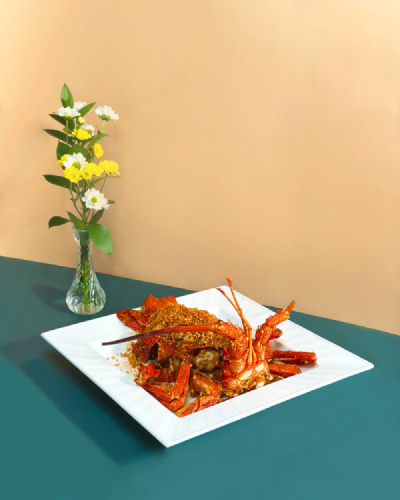
From Maine to the Wok: Why Australian Lobster Belongs on a Cantonese Menu
Not all lobsters are created equal. Some are built for butter and a seaside picnic table. Others are built for the wok. At Li Bai Restaurant, we have always believed the Australian lobster belongs firmly to the latter – and our current lobster promotion, from $19.80 per 100g, is our invitation to prove it.
This is the story of the lobster: where it came from, how different varieties compare, and why the Australian rock lobster is the finest choice for Cantonese fine dining in Singapore.
A Brief History of Lobster: From Poverty to Prestige
Here is something that might surprise you. Lobster was once considered food for the less privileged. When European settlers arrived in North America, lobsters washed ashore in two-foot-high piles after storms. They were so abundant that colonists used them as fish bait and fertiliser. Lobsters were fed to prisoners and early settlers.
Everything changed in the mid-nineteenth century, when railroad expansion allowed fresh lobster to be transported inland. With that, a growing middle class – tasting lobster away from its humble coastal context – found it delectable. By the twentieth century, lobster had completed one of food history’s most remarkable reinventions: from pauper’s staple to prized delicacy.
Maine Lobster or Boston Lobster?
The short answer: there is no difference.
The Maine lobster (Homarus americanus) goes by several names – American lobster, Boston lobster, Atlantic lobster, New England lobster, and Northern lobster – all referring to precisely the same species. The “Boston” label simply reflects the city’s historic role as a seafood distribution port.
What Makes the Maine Lobster Distinctive?
They are found in the cold waters of the Atlantic Ocean from Labrador down to North Carolina, inhabiting rocky and sandy ocean floors at depths of ten to fifty metres. Their most distinctive feature is their asymmetric claw: one heavy crusher claw, one precise cutter claw. This sets them apart from the clawless spiny lobsters of warmer southern waters.
It is the Maine lobster’s growing conditions that make it culinarily exceptional. The crustaceans grow slowly at low temperatures, allowing them to produce firmer, more succulent meat. The cold also stops salt from permeating the flesh – which is why Maine lobster tastes sweeter and cleaner than lobsters from warmer seas.
Simply put, this is a lobster built for restraint. Steam it, boil it, serve it with drawn butter. Let it speak.
Australian Lobster: The Preferred Choice for Cantonese Mastery
While the Maine lobster holds an undisputed place in Western culinary tradition, the Australian rock lobster – a member of the spiny Panulirus Cygnus lobster family is the choice ingredient of fine dining Cantonese restaurants across Asia.
What Makes the Australian Lobster Distinctive?
The Australian rock lobster lacks the large claws of its North Atlantic cousin. Instead, it features an impressive set of spiny antennae, a robust shell, and – most importantly – a large, meaty tail. It is harvested from the pristine, tightly regulated waters off Australia’s northwest and southern coasts.
The flavour profile of Australian lobsters are often described as smooth and delicate, with a natural, less assertive sweetness than the Maine lobster. And its texture? Firm and dense – qualities that make it ideal for the intensity of Cantonese wok cooking.
The Eastern rock lobster (Sagmariasus verreauxi) in particular is celebrated by world-class chefs for its sweet, umami-rich character. It also carries higher concentrations of omega-3 fatty acids than its North Atlantic counterpart – a nutritional edge that reflects the quality of Australia’s clean southern waters.
A Word on Sustainability
Australia’s lobster fisheries are among the most tightly regulated in the world. Quotas are tight. Sustainability assessments are independent and rigorous. When you choose Australian lobster at a Cantonese restaurant in Singapore, you choose quality and environmental responsibility in equal measure. That matters to us at Li Bai.
Li Bai’s Lobster Menu: Three Expressions of Australian Excellence
Our current lobster promotion – available at $19.80 per 100g – presents three distinct preparations, each showcasing the Australian lobster through a different Cantonese lens. Together, they form what we consider a masterclass in how fine dining treats its finest ingredient.
1. Poached Australian Lobster with Garlic and Superior Stock
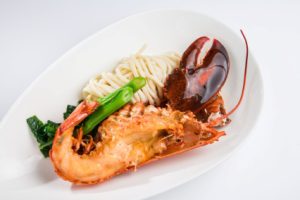
The preparation is deceptively simple – and that is the point. Our superior stock is our secret concoction, built from a careful selection of ingredients. Simmered low and slow for several hours, it reduces into a deeply concentrated, aromatic liquid. To this, we add garlic, onion, and butter, The garlic is warm and mellow. The onion lends quiet sweetness. The butter adds a subtle richness without overwhelming. Australian lobster is then gently poached in the broth, absorbing its depth while keeping its own character entirely intact.
Clean, luminous, silk-smooth. A reminder that the most sophisticated act in a kitchen is often the most considered one.
2. Baked Australian Lobster with Cheese and Home Made Sauce
Cantonese cuisine has never been afraid to engage with Western ingredients – not as fusion, but as confident incorporation. This dish is a perfect example.
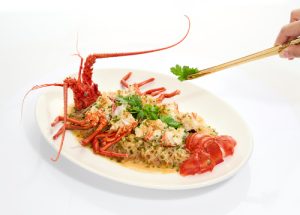
The lobster is baked and finished under heat. As it cooks, our homemade sauce melds with cheese to form a golden, aromatic crust. The cheese is creamy and slightly saline – a counterpoint to the lobster’s sweetness. The sauce bridges both with a proprietary balance that only our kitchen holds.
The Australian lobster’s firm tail is essential here. It holds structure without overcooking. Its clean flavour anchors everything. Comfort and luxury in one dish.
3. Stir-fried Australian Lobster with Deep Fried Garlic and Preserved Black Bean (Bi Feng Tang)
Of all three preparations, this one carries the most history – and the most flavour intensity. A rendition to the famed “Typhoon Shelter Crab” (避風塘炒蟹), this style originated among the boat communities of Hong Kong’s typhoon shelters. In the mid-twentieth century, thousands of mainland Chinese fled to Hong Kong and lived aboard houseboats in these sheltered bays, the largest of which was at Causeway Bay. Out of these floating communities – with their own rhythms and customs – a style of cooking emerged.
What Does Bi Feng Tang Taste Like?
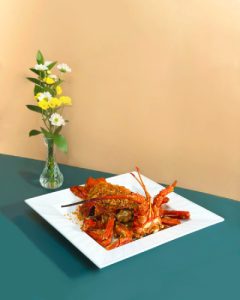
Picture: A generous mountain of slow-fried, golden, crispy garlic. The technique draws out the moisture and harshness from raw garlic at low heat, leaving behind a mellow, nutty crunch. Combined with fermented black beans, dried chilli, and Shaoxing wine, then tossed over fierce wok heat with fresh shellfish – the result is bold, fragrant, and deeply satisfying.
At Li Bai Restaurant, we honour this heritage with complete fidelity to the technique. The garlic is fried low and slow until each piece is crunchily golden. Preserved black beans add umami depth. Stir-fried together at fierce wok heat with the Australian lobster, resulting in Bi Feng Tang Lobster – a dish that is simultaneously bold and nuanced.

Reserve Your Table at Li Bai
Li Bai Restaurant has long held its place among Singapore’s finest Cantonese fine dining destinations. Located at Sheraton Towers Singapore, our Chinese food menu spans the full breadth of Cantonese culinary tradition. From the precision of our dim sum to the wok mastery of our seafood, in an environment that reflects how seriously we take our craft.
Our lobster promotion is not just a price point. It is a statement: that the finest Australian lobster, in the hands of our kitchen team, should be available to everyone who wishes to experience it.
Reserve your table at Li Bai Restaurant →
Frequently Asked Questions
What is the difference between Boston lobster and Maine lobster?
There is no difference. Both refer to the same species, Homarus americanus – also known as the American, Atlantic, or Northern lobster. The “Boston” name comes from the city’s historic role as a major seafood port, not any distinction in the animal. Both have large claws, cold-water sweet meat, and a firm texture best suited to simple Western preparations.
What is Bi Feng Tang flavour?
Bi Feng Tang (避風塘) is a bold, aromatic Hong Kong cooking style from the typhoon shelter fishing communities of Causeway Bay. Its defining flavour comes from slow-fried crispy garlic – cooked at low heat until golden and nutty – combined with fermented black beans, dried chilli, and Shaoxing wine. The profile is smoky, garlicky, and umami-rich, with a satisfying textural crunch. Applied to lobster, the contrast between the delicate shellfish and the intense aromatics is what makes it extraordinary.
What type of lobster is used in Cantonese cuisine?
Fine dining Cantonese restaurants in Singapore and across Asia predominantly use Australian rock lobster (Panulirus cygnus). Its firm texture, generous tail meat, and clean, mildly sweet flavour make it ideal for Cantonese techniques – wok stir-frying, poaching, and baking. While Maine lobster (Homarus americanus) appears in some Chinese-American Cantonese dishes, the Australian rock lobster is the standard in contemporary Cantonese fine dining menus.
Where can I try Australian lobster in Singapore?
Li Bai Restaurant at Sheraton Towers Singapore, 39 Scotts Road, offers a specially curated Australian lobster menu with three Cantonese preparations from $19.80 per 100g. As one of Singapore’s most respected Cantonese fine dining restaurants, Li Bai applies decades of Cantonese kitchen expertise to every lobster dish on the menu.
Li Bai Restaurant is located at Sheraton Towers Singapore. For reservations and enquiries, please visit here
Related reading on our site: Our Menu | Private Dining at Li Bai | What’s On at Li Bai
Follow us on our socials: Facebook | Instagram
Tags: fine dining restaurant Singapore, cantonese restaurant singapore, chinese food menu, australian lobster Singapore, Cantonese seafood Singapore, best lobster Singapore, Chinese lobster dish, li bai restaurant


